.webp) gamescorevibes.com
gamescorevibes.comFactorio: 10 Pro Tips to Build an Efficient Factory and Launch the Rocket Faster
Introduction

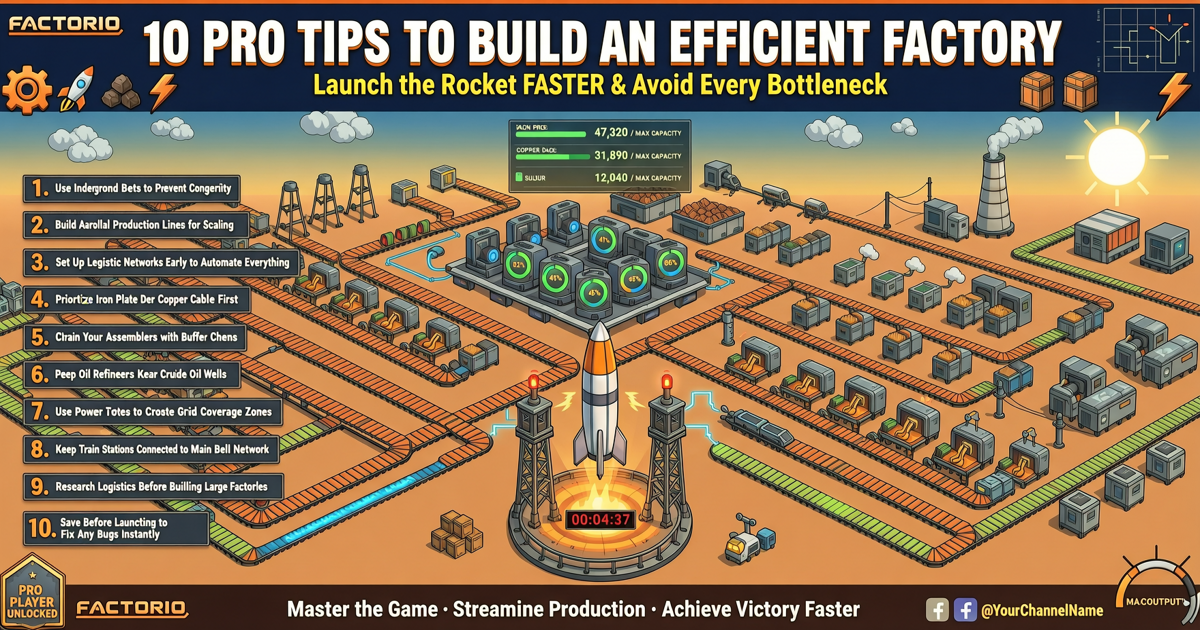
Factorio is a game about automation, efficiency, and scaling up. Whether you're a new engineer or looking to speed up your rocket launch, these ten tips will help you build a factory that runs like clockwork. From early-game smelting to late-game logistics, each tip focuses on practical improvements that save time and resources.
1. Plan Your Bus System from the Start
The main bus is a classic organization method. Reserve four lanes for iron plates, four for copper plates, two for steel, and one each for circuits, plastic, and other essentials. Leave two-tile gaps between groups for underground belts and splitters. A well-planned bus prevents spaghetti and makes expansions easy.
2. Use Direct Insertion for Smelting
Instead of belting ore to furnaces and then plates to assemblers, place miners directly next to furnaces when possible. This reduces belt usage and power drain. For early-game stone furnaces, position them so that output inserts directly into chests or onto a belt. Later, use electric furnaces with productivity modules for maximum efficiency.
3. Automate Early-Game Essentials
Hand-crafting is time-consuming. Automate production of belts, inserters, assemblers, and power poles as soon as you have electricity. Set up a small mall that builds these items continuously. Never hand-craft belts again once you have a basic mall.
4. Master the Splitting and Balancing
Use splitters to balance your bus lanes. A set of three splitters in a ladder configuration can balance 4 lanes. For larger buses, use balancer blueprints from the community. Balanced lanes ensure all parts of your factory get the resources they need, preventing starvation.
5. Utilize Trains for Long-Distance Transport
Once your starter patches run low, trains become essential. Set up a simple 1-2 train (1 locomotive, 2 cargo wagons) with two rails for each direction. Use signals to prevent collisions. Design a standardized unloading station with buffer chests to keep your factory fed.
6. Build a Modular Smelting Array
Instead of a single smelting line, build multiple independent arrays. For example, a 24-furnace array for iron and a separate one for copper. Each array outputs to a belt that feeds into your bus. This allows you to expand smelting capacity without rebuilding the whole line.
7. Use Ratio Mathematics
Factorio has perfect ratios. For example, 1 offshore pump feeds 20 boilers, which feed 40 steam engines. For green circuits, 3 copper cable assemblers feed 2 circuit assemblers. Learning key ratios avoids overproduction or underproduction. Use a calculator mod or wiki to plan ratios for higher-tier items like modules and science packs.
8. Incorporate Productivity Modules in Key Steps
Productivity modules add free items. Place them in furnaces, assemblers for circuits, and labs. The bonus items more than offset the speed penalty and power cost. Use speed modules in beacons to compensate. Aim for productivity modules in all intermediate products.
9. Set Up Logistic Bots Early
Once you unlock requester chests, logistic bots can handle item delivery for your mall and repair packs. Use a separate network for your base and outposts. Bots drastically reduce the need for long belts and improve construction speed. However, don't rely on them for high-throughput items like plates; belts are more efficient for bulk.
10. Prioritize Military Science for Evolution Control
Biters become stronger as pollution spreads and time passes. Rushing military science (gray science) lets you build turrets, walls, and damage upgrades. Use flamethrower turrets for area denial. Keep your pollution cloud clear by using efficiency modules in miners and using solar power to reduce coal consumption.
Conclusion
These ten tips will help you build a factory that scales smoothly to rocket launch. Remember: the factory must grow. Plan your expansions, use ratios, and automate everything. With practice, you'll launch rockets in a fraction of the time. Happy automating!